
There is no speed limit, but there are patterns that look earned and patterns that look manufactured. Here is how to tell the difference.
Link velocity is the rate at which a website gains new backlinks over time, usually measured as new referring domains per month. It gets attention because unnatural acquisition patterns, hundreds of links appearing overnight from thin, unrelated sites, are a classic footprint of manipulation, while steady growth from genuine outreach mirrors how real authority accumulates.
The critical nuance: search engines evaluate patterns, not speedometers. A startup that goes viral can earn a thousand links in a week without issue, while a quiet affiliate site gaining fifty spammy links a month can attract scrutiny. Context, source quality, relevance, anchor distribution, matters far more than raw pace.
So the right question isn't how many links per month are safe, but whether your growth looks like something real success produces. Everything below is about building velocity that answers yes.
Link velocity is your link acquisition rate over time. What matters isn't the speed, it's whether the pattern looks earned.
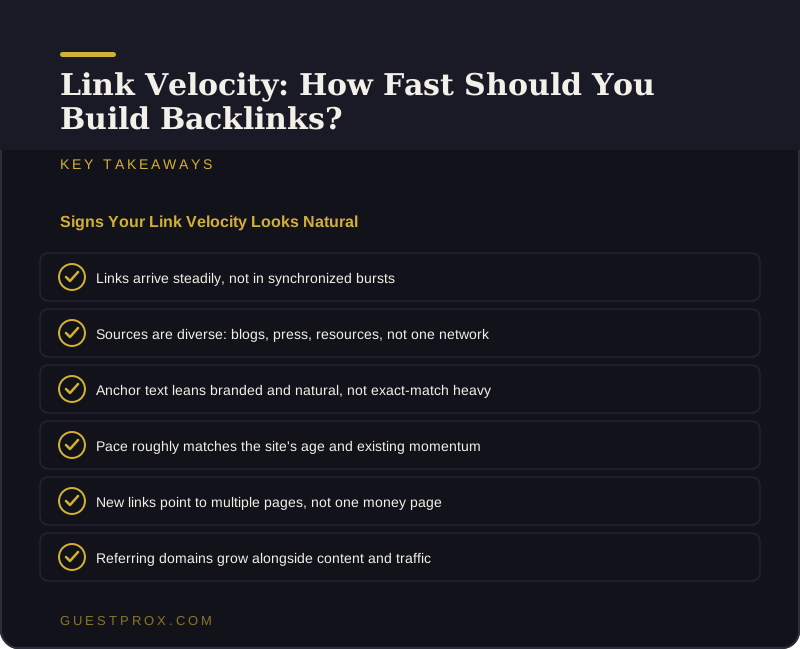
Search engines hold years of link-graph history for established sites, which makes anomalies visible: a flat profile suddenly spiking, links arriving in synchronized bursts from unrelated domains, anchor text distributions shifting overnight. None of these alone proves manipulation, real events cause spikes too, but together they form the pattern that gets flagged.
Product launches, press coverage, viral content, and awards all create legitimate link bursts. The difference is in the sources: real spikes come from diverse, relevant publications writing about something newsworthy. Manufactured spikes come from networks of thin sites with no editorial reason to link.
More dangerous than any spike is a constant drip of low-quality links, the signature of cheap link packages. Fifty directory and PBN links a month, every month, builds a profile that looks nothing like organic growth. Slow does not mean safe when the sources are garbage, and anomalies in backlink velocity are easiest to spot in exactly this metronomic pattern.
Since there is no official threshold, setting your link acquisition rate is a judgment call. These are the heuristics we use when planning GuestProx campaigns, conservative by design, because a profile built slowly can always accelerate, while a burned profile is expensive to clean.
A brand-new domain earning 30 links in its first month looks odd unless something newsworthy happened. We start new sites with a handful of quality placements monthly and increase as content, traffic, and brand signals grow. The profile should mature alongside the business.
A site already earning links naturally can absorb a faster campaign pace without blinking, the new links blend into existing growth. The rule of thumb: your built velocity shouldn't dwarf your earned velocity for long. If you naturally gain 10 links a month, adding 15-20 via outreach reads as growth; adding 200 reads as an event that never happened.
Velocity problems rarely travel alone, they arrive with over-optimized anchor text and repetitive source types. Vary anchors toward branded and natural phrases, mix publication types, and let some months be quieter. Monotony is the real footprint, not speed.
If a past campaign, yours or an agency's, left you with a suspicious spike, don't panic and don't nuke the profile. Recovery is usually about dilution and patience, not demolition. One more thing worth doing from the start: keep a simple log of when each placement went live and where. If you ever need to explain your profile, to a client, a boss, or yourself in a year, that log is worth more than any tool's verdict.
Export your full referring-domain history and mark the spike: when it started, which domains drove it, and what anchors came with it. Most of the time the damage is concentrated in one burst from one source type, which makes the fix straightforward.
The instinct is to disavow everything, but mass disavows can remove links that were actually helping. Start by building a steady stream of legitimate editorial links, real publications, natural anchors, so the spike becomes a smaller share of a healthier profile. Disavow only the clearly manipulative remainder, and do it in stages so you can measure the effect.
Once the ratio normalizes, keep the steady cadence from the checklist above. Profiles recover credibility the same way they build it: months of boring, legitimate growth. There are no shortcuts here, which is exactly why pacing discipline matters from day one.
Check your profile against these before scaling up.
Pacing, anchors, and keeping your profile clean.
Authoritative sources if you want to go deeper on this topic.
There is no official safe number, it depends on your site's age, existing profile, and what's causing the links. A new site should start with a handful of quality placements monthly; an established brand can sustain far more. Anyone selling you a specific safe quota is inventing it.
Speed alone rarely causes problems; manufactured patterns do. A thousand links from a viral launch is fine. Fifty links a month from link networks is not. Search engines weigh source quality, relevance, and anchor behavior together with pace.
Yes. A new domain with no traffic or content history earning dozens of links immediately looks out of place. Ramp up as the site matures, start with a few strong placements monthly and scale with your content and brand.
No, real attention is the safest link velocity there is. Spikes from genuine coverage come from diverse, relevant sources writing about something real. That is exactly what natural authority looks like.
Pausing doesn't erase what you've built, but momentum matters in competitive niches where rivals keep building. Consistency beats intensity: steady monthly progress outperforms stop-start bursts, both for rankings and for keeping the profile natural.
Steadily. We deliver placements on a consistent monthly rhythm rather than dumping everything at once, and we scale pace with your site's maturity. Every link comes from a real, trafficked publication, which is what makes the velocity defensible in the first place.
We pace every campaign for long-term safety. Message us on WhatsApp at +1 (213) 582-6001 about your goals.
Global Service Delivery