
Two tactics, one goal: authoritative contextual backlinks. Here is an honest breakdown of where each wins, where each falls short, and how to combine them.
Guest posting earns links through new articles published on other websites. Niche edits, also called link insertions, place your link inside existing articles that already rank and already get traffic. Both produce contextual backlinks; they differ in speed, control, and what you're really buying.
The honest answer to 'which should you use' is: it depends on your timeline, your content resources, and your risk tolerance. Most mature campaigns use both deliberately. This post gives you the framework to decide the mix.
Guest posting creates new articles to house your links; niche edits insert your links into existing ranking articles. Same goal, different tradeoffs.
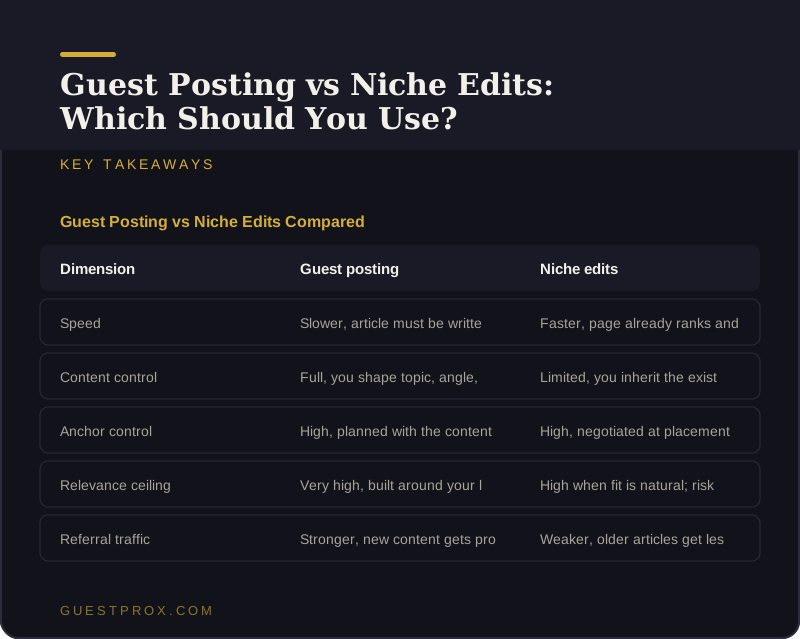
Four dimensions decide which tactic fits a given situation.
Niche edits win on speed. The page already exists, already ranks, and already has authority, your link starts working as soon as it's placed and indexed. Guest posts start from zero: the article must be written, published, and then earn its own authority over time.
If you need movement this quarter, niche edits deserve a serious look. If you're building for the long term, guest posting's compounding value matters more.
Guest posting gives you full control: you shape the topic, the angle, the surrounding content, and the anchor text. The article exists to support your link naturally. With niche edits, you inherit someone else's article, you can choose placement and anchor, but the content and context are fixed.
That control matters most when targeting specific keywords or when your niche needs careful framing. It matters less when the existing article is already a perfect topical fit.
A well-executed guest post can achieve perfect relevance: the right topic, on the right site, with your link in the ideal paragraph. Niche edits depend on finding existing articles where your link fits without forcing it, when the fit is natural, the relevance is excellent; when it's stretched, editors (and algorithms) notice.
Vetting matters more for niche edits, not less. An insertion into a spammy old article is worse than no link at all.
Both are safe when done with real sites and real editorial relationships, and both are dangerous when done through link sellers. The specific risk with niche edits is hacked or repurposed old content, always verify the article's history. The specific risk with guest posting is volume-driven outreach landing you on link farms. Same rule for both: vet the site, not the tactic.
Match the tactic to the situation.
You're targeting specific keywords and want full anchor and content control. You're building topical authority in a niche where fresh, expert content gets noticed. You want referral traffic from engaged readerships. You're an agency that needs predictable, repeatable fulfillment with content your clients can see.
You need faster impact and the right existing articles exist in your niche. Your target pages are commercial and hard to build natural content around. You've found genuinely authoritative older articles where your resource is the obvious missing citation. Your content production bandwidth is limited.
Strong campaigns rarely pick one. A typical mix: guest posting as the steady foundation, controlled, compounding, brand-safe, with niche edits layered in for speed on priority keywords. The ratio shifts with goals: new sites lean guest posting for natural profile growth; established sites chasing competitive terms lean on strategic insertions.
We run both for clients, and we're direct about which we'd recommend for your situation. Our honest answer to guest posting vs niche edits is usually 'both, in a planned ratio', but we'll tell you when it's one or the other. Sometimes the answer is one tactic; often it's a planned mix.
Side by side on what matters.
| Dimension | Guest posting | Niche edits |
|---|---|---|
| Speed | Slower, article must be written and gain authority | Faster, page already ranks and holds authority |
| Content control | Full, you shape topic, angle, and context | Limited, you inherit the existing article |
| Anchor control | High, planned with the content | High, negotiated at placement |
| Relevance ceiling | Very high, built around your link | High when fit is natural; risky when forced |
| Referral traffic | Stronger, new content gets promoted and read | Weaker, older articles get less fresh traffic |
| Best for | Long-term authority, keyword targeting, agencies | Quick wins, commercial pages, limited content bandwidth |
Comparison is only useful if you measure both sides the same way.
Links work together, a guest post and a niche edit pointing at related pages amplify each other, and isolating each link's contribution is genuinely hard. Don't expect clean per-link ROI. Measure at the campaign and page level, where the signal is real.
For guest posting: placements live, referring domains added, referral traffic from articles, keyword movement on targeted pages. For niche edits: the same, plus time-to-impact, insertions on already-ranking pages often move faster, and that speed difference is worth quantifying for your niche.
Give any mix a full quarter before judging. Review which tactic drove movement on which pages, whether the anchor distribution stayed natural, and whether the pace looked editorial. Then rebalance the mix, strategy is a loop, not a one-time choice.
The vetting bar is the same height for both tactics, but it measures different things. For guest posting, you're vetting the publication's future: will this site still be a respectable editorial property in a year? Traffic trend, content quality, outbound patterns, the standard checks from our publisher evaluations. You're betting on where the site is going.
For niche edits, you're vetting the article's past. That page already exists, which means it has a history, and histories can be ugly. Check whether the article's topic has drifted over time, whether the page was recently repurposed from something unrelated, and whether its backlink profile looks editorial or manufactured. An insertion into a page with a hacked or spammy past inherits that past.
The practical difference: guest post vetting is mostly about the domain, niche edit vetting is mostly about the URL. A great site can host a bad insertion target, a thin old post, a page stuffed with previous insertions, an article whose traffic collapsed two years ago. Always evaluate the specific page, not just the site around it. Our niche edits service runs page-level history checks for exactly this reason.
One more niche-edit-specific check: insertion density. Open the target article and count existing commercial outbound links. One or two is a healthy page; five-plus means the page is already monetized heavily, and your link joins a crowded, devaluing neighborhood. Editors selling unlimited insertions per article are running the same playbook as link farms, just on older content.
For guest posting, the equivalent forward-looking check is editorial trajectory: is the site's content getting better or thinner? A publication ramping up guest post volume quarter over quarter is monetizing, and today's selective editor becomes tomorrow's link seller. Vetting isn't a stamp, it's a reading of direction, and the direction matters differently per tactic.
Every tactic has a characteristic failure mode, and knowing them in advance is what lets you build a mix that hedges instead of doubles down. Guest posting breaks through drift: placements start on great publications, standards slip as volume grows, and a year later your 'editorial' links sit on sites that now publish anything. The defense is continuous re-vetting and a fixed quality floor that volume pressure never moves.
Niche edits break through decay. The target article was perfect at insertion, ranking, trafficked, relevant, then the page lost rankings, traffic dried up, or the site restructured and the content thinned. Your link is still there; its value isn't. The defense is choosing pages with durable topical demand, reference-style content that ages well, over news-cycle pages that peak and fade.
Both tactics break through anchor laziness, and this one is entirely self-inflicted. Guest posting tempts you with control, every anchor exactly as planned, which makes it easy to over-optimize without noticing. Niche edits tempt you with speed, quick insertions, quick anchors, which makes it easy to skip the distribution planning. The fix is the same spreadsheet for both, planned, tracked, natural-looking anchor distribution across the whole campaign, as our anchor text guide covers in detail.
The meta-lesson: diversify across failure modes, not just tactics. A campaign of fifty guest posts on similar mid-tier blogs shares one failure mode; a campaign split across guest posts, strategic insertions, and digital PR mentions spreads the risk. That's the real argument for the hybrid mix, not that each tactic is good, but that they fail differently.
Both tactics, done properly.
Authoritative sources if you want to go deeper on this topic.
Neither tactic is inherently safer, safety comes from the sites, not the method. Real publications with real traffic make both safe; link sellers make both dangerous. Niche edits have one extra check: verify the article's history to rule out hacked or repurposed content. We apply the same vetting bar to both.
Niche edits, usually. The host page already has authority and rankings, so your link starts counting sooner. Guest posts need time for the new article to be crawled, indexed, and evaluated. If timeline is your primary constraint, say so up front, it changes the recommended mix.
Yes, and most strong campaigns do. Guest posting builds the controlled, compounding foundation; niche edits add speed on priority keywords. We plan the ratio around your goals rather than defaulting to one tactic, new sites usually lean guest posting, established sites chasing competitive terms use more insertions.
We don't publish prices for any link type. Message us on WhatsApp at +1 (213) 582-6001 for a quote scoped to your project.
Guest posting, generally. On guest posting vs niche edits for new sites, fresh editorial content builds a natural-looking profile cleanly, while aggressive insertion buying can look unnatural early on. New sites need natural-looking profile growth, and fresh editorial content with varied anchors builds that cleanly. Aggressive niche-edit buying on a new domain can look unnatural. Start with guest posting as the foundation and layer in insertions as the site matures.
Legitimate niche edits are arranged with the site owner or editor directly, it's a transparent commercial arrangement for an editorial insertion, not a hack. Anyone offering 'niche edits' without publisher contact is selling something else. We only place insertions with the publisher's knowledge and approval.
Message us on WhatsApp at +1 (213) 582-6001 or send the form below. We'll look at your site and recommend the mix honestly, even if the answer is one tactic, not two.
Global Service Delivery