
Domain Rating and Domain Authority get used as if they were the same number. They come from different companies, different data, and different math. Here is what each one actually tells you.
DR (Domain Rating) is Ahrefs' 0-100 score for a website's backlink strength, built from the number and quality of its referring domains on a logarithmic scale. DA (Domain Authority) is Moz's 0-100 score, produced by a machine-learning model trained to predict how well a site is likely to compete in search results. They are built by different companies from different link indexes, which is why DR vs DA scores for the same website rarely match.
Neither number comes from Google. Both are third-party estimates trying to approximate something Google measures internally and never publishes. Treating either as a ranking factor is the most common mistake in link buying, they are screening tools, not scores that Google keeps.
Used correctly, they save enormous time: a quick DR or DA check filters out obvious junk before you spend an hour vetting a site. Used incorrectly, treating domain rating vs domain authority as interchangeable, or chasing the highest number regardless of traffic, they lead straight into manipulated metrics and wasted effort.
DR measures backlink power through Ahrefs' link index; DA predicts ranking competitiveness through Moz's model. Neither is a Google metric, and they should never be compared against each other.
Ahrefs calculates DR primarily from referring domains: unique websites linking to the target with dofollow links. A link counts more when it comes from a site with high DR itself, and less when the linking page points to thousands of other sites. The scale is logarithmic, so climbing from DR 20 to 30 takes far fewer quality links than climbing from 80 to 90.
DR does one thing well: it summarizes raw backlink power. If two sites are otherwise similar, the one with substantially higher DR usually has the stronger link profile. It also updates quickly as Ahrefs discovers new links, so it reflects recent link building activity better than slower-moving metrics.
DR says nothing about traffic, content quality, topical relevance, or whether anyone actually visits the site. A domain can hold DR 65 on legacy links while publishing nothing anyone reads. It also cannot tell you if a site was penalized, rebuilt on an expired domain to inherit old links, or exists only to sell placements, all things we check manually before pitching.
Moz takes a different approach. Instead of a pure link-power formula, it trains a machine-learning model on actual search results, trying to predict which sites rank. The inputs come from Moz's own link index, linking root domains, total links, and quality signals, and the output is tuned so DA tracks with observed competitiveness.
Because the model is retrained periodically rather than updated continuously, DA tends to move in jumps when Moz refreshes its index. A site can sit at the same DA for months and shift several points overnight without gaining or losing a single link. That is normal behavior for the metric, not a signal about the site itself.
Ahrefs and Moz crawl different portions of the web, so they literally see different backlink profiles for the same domain. When DR and DA disagree sharply, part of the gap is just coverage: one tool found links the other hasn't discovered. This is also why judging a site on one tool's number alone is a mistake.
Pick one ecosystem and stay inside it. If your team works in Ahrefs, evaluate every prospect in DR and stop converting scores in your head. The Ahrefs vs Moz comparison only makes sense within a single tool's data, a DR 50 is not better or worse than a DA 55, because the numbers are not on the same ruler.
DR is the more gamed of the two, because its formula is better understood. Expired domains with historic links get rebuilt into fake blogs, link schemes inflate referring-domain counts, and sellers advertise the resulting DR as if it meant authority. Our defense is simple: we verify organic traffic before pitching anything. Traffic is far harder to fake than a metric, and a DR 70 site with no visitors is worth less than a DR 35 site with a real audience.
We use DR as a first filter, placements go on DR 40-90 sites, and then traffic and editorial quality decide. The metric opens the door; manual vetting decides who walks through. Any vendor quoting a DR number without showing traffic data is selling you the ruler instead of the measurement.
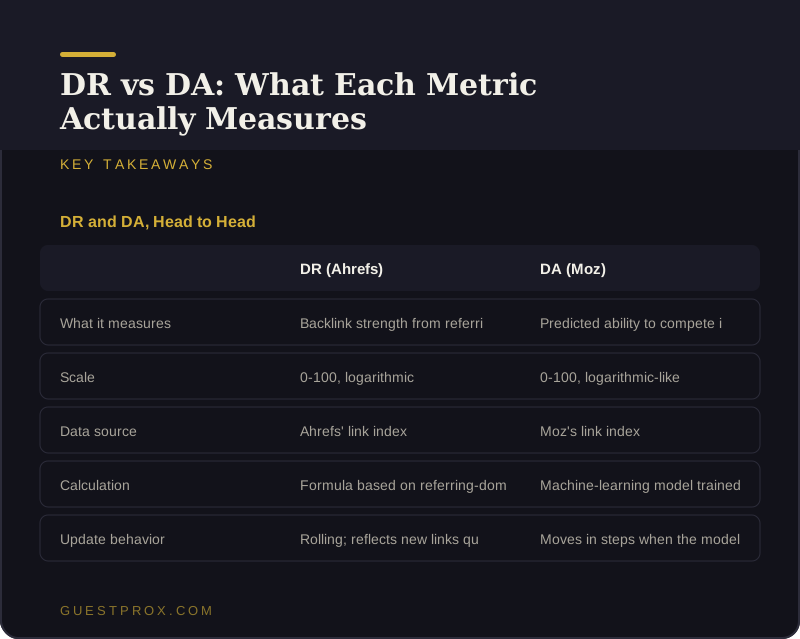
The same domain seen through two different lenses.
| DR (Ahrefs) | DA (Moz) | |
|---|---|---|
| What it measures | Backlink strength from referring domains | Predicted ability to compete in SERPs |
| Scale | 0-100, logarithmic | 0-100, logarithmic-like |
| Data source | Ahrefs' link index | Moz's link index |
| Calculation | Formula based on referring-domain quantity and quality | Machine-learning model trained on search results |
| Update behavior | Rolling; reflects new links quickly | Moves in steps when the model refreshes |
| Biggest weakness | Can be inflated with manipulated links | Lags behind real changes in the link profile |
| Best used for | Comparing link power inside Ahrefs data | Comparing competitiveness inside Moz data |
Go deeper on metrics and link quality.
Authoritative sources if you want to go deeper on this topic.
Neither is accurate in the way people want them to be, both are estimates, and neither comes from Google. DR is a more direct read of backlink power; DA is tuned to predict ranking competitiveness. Use them for relative comparison inside one tool, not as absolute grades.
Because Ahrefs and Moz crawl different link indexes and run different formulas. A gap of 10-15 points between the two is completely normal. Large gaps usually mean one tool is missing a chunk of your backlinks, or the other is counting links the first discounts.
No. Google has its own internal signals for link-based authority and has never used third-party metrics. DR and DA try to approximate what Google might see, but they are screening tools for SEOs, not ranking factors.
Yes, and it happens constantly. Rebuilt expired domains, private blog networks, and link schemes can all inflate referring-domain counts and push DR up. That is why traffic verification matters more than the number, a DR 70 site with no organic visitors is a decorated empty room.
We place on DR 40-90 sites, but the number alone never closes the deal, every prospect also needs real organic traffic and genuine editorial standards. A DR 45 site your audience actually reads beats a DR 75 link farm every time.
No, that is the single most common metrics mistake. The scales are built differently from different data. Compare DR to DR and DA to DA, or better yet, compare the underlying link profiles directly: referring domains, traffic, and relevance.
We check DR, traffic, and editorial quality before every pitch. Message us on WhatsApp at +1 (213) 582-6001 and tell us about your site.
Global Service Delivery