
AI answers cite brands they recognize from authoritative sources. This playbook covers the content, PR, and consistency work that makes your brand one of them.
Being citable by AI search means AI-generated answers reference your brand, quote your content, or link to your pages when responding to user questions. A citation is the AI equivalent of a ranking: it puts your brand in front of the user at the moment of the question.
Citations flow to brands the AI system recognizes as authoritative on the topic. That recognition comes from the same raw material as traditional authority: editorial coverage, expert quotes, original data, and consistent, accurate information about your brand across the web.
This playbook covers the practical work behind citability. Each tactic is marked as established practice or emerging, so you know what is proven and what is informed reasoning.
AI citability is the likelihood that AI-generated answers reference your brand, built through authoritative coverage, expert content, and consistent entity information.
AI answers are built from content that states things clearly. The pages that get cited share structural traits you can deliberately build into your content.
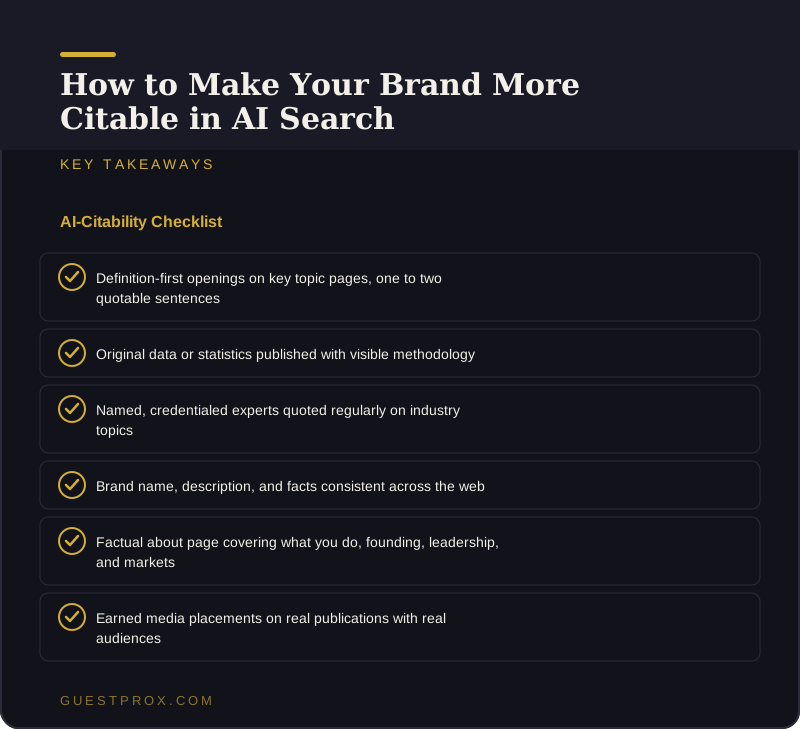
AI Overviews and LLM answers favor content that defines terms plainly in the opening lines. A page that begins with a direct, quotable definition of its topic is structurally easier for these systems to lift than one that buries the answer in paragraph four.
This is established practice because it mirrors what already wins featured snippets, and AI answers draw heavily from snippet-style content. Put the definition first, keep it to one or two sentences, and make it self-contained.
Numbers nobody else has are among the most-cited content on the web, and AI answers are no exception. Original surveys, proprietary data, and fresh statistics give AI systems something to cite that only you can provide.
Publish the methodology alongside the numbers. AI systems and the journalists who amplify them both prefer data with visible sourcing. One solid original study can generate citations for years.
AI answers explaining complex topics reach for expert voices. Named experts with credentials, quoted in clear, opinionated sentences, get picked up because they add something the AI cannot generate itself: a human judgment.
Build a bench of quotable experts in your organization. Publish their commentary on industry developments, keep the quotes tight and specific, and make the expert's credentials visible. Vague corporate statements are never cited.
Content organized around direct questions, with concise answers followed by supporting detail, appears well-suited to how AI systems extract information. Clear headings, short paragraphs, and FAQ-style structures all help.
This is marked emerging because the mechanism is inferred from observed citation patterns rather than confirmed by providers. It is low-cost to implement and aligns with good UX anyway, so there is little downside.
An AI system can only cite a brand it can confidently identify. Scattered, contradictory information about your business makes you harder to recognize as a single entity.
Your brand name, description, leadership, founding details, and what you do should read the same across your site, directories, profiles, and press coverage. Inconsistencies, old taglines, conflicting descriptions, dilute entity recognition.
Audit your brand's footprint the way you would audit NAP consistency for local SEO. Fix the outliers. This is unglamorous work with real compounding value.
Your about page is often the canonical source AI systems use for who you are. Make it factual and complete: what the company does, when it was founded, who leads it, where it operates, and what it is known for. Skip the mission-statement poetry.
Include the facts a journalist would need in the first screen. If an AI answer describes your brand, you want it drawing from your words, not from a third-party guess.
Structured knowledge bases feed the entity understanding of AI systems, and accurate entries help. For brands notable enough to qualify, correct information in these sources supports recognition.
This is emerging because qualification thresholds are high and the direct citation impact is unproven. Do not manufacture notability to force an entry. If you qualify, keep the entry accurate.
Mentions across credible publications build the entity recognition that underlies citations. This is where link building and AI citability share the same engine.
Every editorial placement does double duty: the backlink strengthens traditional authority, and the brand mention strengthens entity recognition. Coverage in publications your industry reads is the highest-value input for both.
Prioritize publications with real audiences and real editorial standards. A mention in a respected trade publication outweighs ten mentions on sites nobody reads, for AI citability exactly as for SEO.
A quotable expert gets cited across multiple outlets, and each citation reinforces the brand-entity association. One strong commentary campaign can put your brand's name in front of AI training data dozens of times over.
The compounding matters more than any single placement. Consistency of expert presence, quarter after quarter, is what turns a brand into a recognized entity.
Do not manufacture mentions through paid placements disguised as editorial, do not stuff your brand name into irrelevant content, and do not trust vendors promising AI citations at scale. Fabricated entity signals are the fastest way to look like spam to both algorithms and humans.
The honest path is slower and it works: real expertise, real publications, real consistency. Everything else is a shortcut to a penalty or an embarrassment.
Work through this list to make your brand easier for AI systems to recognize and cite.
Digital PR services, outreach, and what the evidence says about links and AI search.
Authoritative sources if you want to go deeper on this topic.
There is no fixed timeline, and anyone giving you one is guessing. Entity recognition builds through sustained editorial coverage and consistent brand presence, typically over quarters rather than weeks. Track your inputs, placements, mentions, expert quotes, and watch citation trends monthly.
We don't publish prices. Message us on WhatsApp at +1 (213) 582-6001 for a quote.
No, and you should walk away from any vendor who says they can. No provider has disclosed how citations are selected, and the systems change constantly. We build the verifiable inputs that correlate with citations, editorial placements and brand mentions on real publications, and report them honestly.
Digital PR has the edge for entity recognition because earned coverage and expert quotes generate the brand mentions AI systems train on. Guest posting builds the backlink foundation that underlies traditional authority. The strongest programs run both, which is how our outreach is structured.
Yes. Your about page is often the canonical source for who your brand is, and AI answers describing your company draw from it. Keep it factual and complete: what you do, when founded, leadership, markets served. Skip the vague mission language in favor of facts a journalist could use.
Chasing shortcuts: paid mentions disguised as editorial, brand-name stuffing, and vendors selling guaranteed citations. These either do nothing or actively damage credibility. The durable approach is unglamorous, real expertise published consistently on real publications, quarter after quarter.
We earn the editorial placements and brand mentions that make brands citable, on real DR 40-90 sites with full reporting. Message us on WhatsApp at +1 (213) 582-6001 or use the contact form.
Global Service Delivery