
Both earn editorial backlinks from real publications. But the mechanics, the control you keep, and the timelines are completely different. Here is how to choose.
Guest posting and digital PR are both ways to earn editorial backlinks, but they work in opposite directions. With guest posting, you write an article for a publisher and earn a link placed inside it. With digital PR, you create something newsworthy, original data, a study, a strong expert angle, and journalists link to you when they cover it.
The confusion is understandable. Both involve outreach, both land you on real publications, and both outperform buying links from marketplaces. But the skills required, the level of control, and the timelines are completely different. Choosing the wrong one for your situation can waste months.
This post breaks down how each tactic actually works, where they overlap, and how to decide which fits your goals, including when running both together is the right call. If you want the outreach handled, our guest posting service runs the publication side while our digital PR team handles newsworthy assets.
Guest posting earns links by contributing content to publishers; digital PR earns links by giving journalists something worth covering.
Strip away the jargon and the two tactics solve opposite problems. Guest posting solves a publisher's content problem. Digital PR solves a journalist's story problem. That single difference explains almost everything about how they behave in practice.
You identify a publication in your niche, pitch article ideas to its editor, write the piece, and include a contextual link back to your site. The publisher gets free, relevant content. You get a dofollow link with anchor text you helped choose.
Because you produce the content, control is high: you decide the topic angle, the anchor text, and which page receives the link. Scale is linear and predictable, more outreach hours produce more placements. Our team has delivered over 1259 guest posts this way, and the pattern holds: consistent input, consistent output.
You create an asset a journalist wants to reference: survey data, an industry study, a data-driven ranking, or genuine expert commentary on a trending story. Then you pitch it to journalists and news desks. When they write the story, they link to your asset as the source.
Control is low. The journalist writes the story, chooses the anchor (usually your brand name), and may even nofollow the link on large news sites. But the upside is asymmetric: one strong asset can earn dozens of links from high-authority domains in a single news cycle, something guest posting cannot replicate.
Here is the practical comparison we walk clients through before recommending either tactic. Neither is universally better. They are different tools.
Guest posting gives you the steering wheel. You approve the topic, write the draft, and negotiate the anchor. Digital PR hands the wheel to the journalist. You can suggest an angle, but the final story, and whether your link is dofollow, is their call.
If precise anchor text on a specific money page matters to your strategy, guest posting is the reliable route. If brand-level authority and visibility matter more, digital PR's unpredictability is worth accepting.
Guest posting scales like a production line. Double the outreach volume and you roughly double the placements, with timelines measured in weeks from pitch to live link. Budgeting and forecasting are straightforward.
Digital PR scales like venture capital. Most assets earn modest coverage; a few break out and earn fifty links in a week. Timelines depend on news cycles, a great study can sit quiet for a month, then explode when a related story trends.
Digital PR links often come from the highest-authority domains on the internet: national news, major industry press. Even when some are nofollow, the combination of authority, brand mentions, and referral traffic is powerful.
Guest posting links come from niche-relevant blogs and trade publications. Individually less authoritative than a national news link, but far more topically relevant, and relevance is what moves rankings for specific keywords.
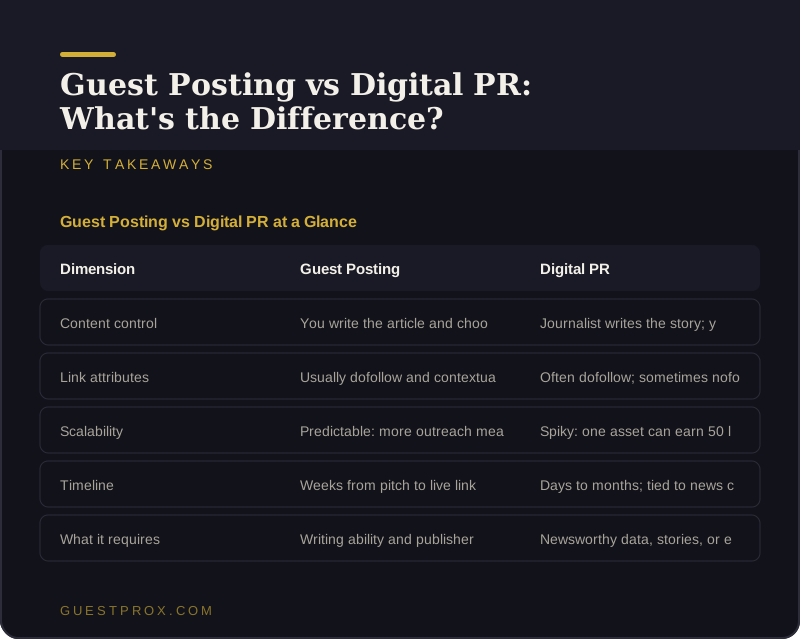
The six dimensions that actually change campaign decisions.
| Dimension | Guest Posting | Digital PR |
|---|---|---|
| Content control | You write the article and choose the anchor | Journalist writes the story; you get a brand mention |
| Link attributes | Usually dofollow and contextual | Often dofollow; sometimes nofollow on large news sites |
| Scalability | Predictable: more outreach means more placements | Spiky: one asset can earn 50 links or none |
| Timeline | Weeks from pitch to live link | Days to months; tied to news cycles |
| What it requires | Writing ability and publisher relationships | Newsworthy data, stories, or expertise |
| Best for | Steady authority building and targeted anchors | Brand visibility and high-authority spikes |
The honest answer: it depends on what your link profile is missing. Most sites we audit are missing one of two things, steady, relevant links to specific pages, or high-authority brand-level links. Your gap decides the tactic.
You need links to specific service, product, or category pages with controlled anchor text. You want predictable monthly output you can report on. Your niche has strong trade publications that accept contributions. Or you are an agency that needs reliable white-label fulfillment for clients.
Your brand already has some authority and you want the kind of links competitors cannot easily replicate. You have access to proprietary data, original research, or genuine expertise on trending topics. Or your link profile is heavy on niche blogs and missing top-tier domains.
The strongest campaigns we see combine the two. Guest posting builds the steady foundation, relevant links to the pages that need to rank, month after month. Digital PR adds the spikes, high-authority coverage that lifts the whole domain. The guest posts keep working while you wait for the next news cycle, and the digital PR wins make every subsequent guest post pitch easier because editors recognize your brand.
Guest posting budgets behave like a subscription: you commit to a monthly placement volume and the output arrives on a steady cadence you can forecast. Digital PR budgets behave like research spending: you fund asset creation and pitching up front, then wait for a news cycle to cooperate. Neither model is wrong, but they need different expectations set before money moves.
Timelines tell the same story. A guest post typically moves from pitch to live link in three to six weeks, so a campaign starting today produces reportable results this quarter. A digital PR asset, an original survey, a data study, takes weeks just to build, and coverage then depends on journalists and timing. That is why guest posting runs on monthly calendars while PR work is planned in quarters.
Reporting differs too. Guest posting reports are concrete: live URLs, anchors, target pages, and site traffic at placement time. Digital PR reports read like media coverage summaries: outlets, domain caliber, brand mentions, referral spikes. Judge PR by links-per-month and it will always look like a failure in month one, so our digital PR link building guide explains which numbers actually signal progress.
The practical move is a split: fund the predictable base first, then add the asymmetric upside. Decide how many steady placements you need monthly to move target pages, lock that in, and let digital PR be the layer that multiplies a quarter when a story lands. When we run both, PR campaigns follow news cycles while guest posting holds monthly velocity steady underneath.
First: do you need links to specific pages with specific anchors? If yes, guest posting is the reliable route, you control topic, anchor, and target. Second: do you have proprietary data, original research, or genuine expertise on a trending topic? If yes, digital PR has raw material worth pitching.
Third: what is your timeline? Anything under ninety days favors guest posting; PR assets can sit quiet for months before a story makes them relevant. Fourth: can you tolerate a quarter with little to show? PR is spiky by nature, most assets earn modest coverage and a few break out.
Fifth: what is your profile actually missing? Pull a competitor gap analysis and look: missing steady relevant links to money pages means guest posting; missing top-tier authority domains means PR. Most audits reveal one clear gap, and the gap decides the tactic. A competitor link gap analysis is the fastest way to see that gap in numbers.
Agencies face a sixth question: can you promise clients predictable output? White-label fulfillment lives or dies on reliability, which is why our white-label link building is built on the guest posting production line rather than the PR lottery. Answer these questions honestly and the choice makes itself.
Go deeper on each tactic and the metrics that judge them.
Authoritative sources if you want to go deeper on this topic.
Neither wins universally, which is why the digital PR vs guest posts debate never quite settles. Guest posting is better when you need controlled, relevant links to specific pages on a predictable schedule. Digital PR is better when you want high-authority brand links and visibility spikes. Most mature link profiles need both: guest posting for the foundation, digital PR for the peaks.
Yes, large news sites often nofollow external links, and no, that does not make them worthless. Nofollow press links still drive referral traffic, build brand recognition that makes future outreach easier, and contribute to a natural-looking link profile. Google has also confirmed it treats nofollow as a hint, not a directive to ignore.
Guest posting typically moves from pitch to live link in weeks, on a fairly reliable cadence. Digital PR is tied to news cycles: an asset can earn coverage in days or sit quiet for months before a trending story makes it relevant. Plan digital PR in quarters, guest posting in months.
No. Mass press releases are one of the weakest forms of digital PR and rarely earn real editorial links. Effective digital PR means creating something genuinely newsworthy, original data, a contrarian expert take, a useful tool, and pitching it to specific journalists who cover that beat.
We don't publish prices. Message us on WhatsApp at +1 (213) 582-6001 for a quote.
Yes, and there is an advantage to it: the publisher relationships built through guest posting make digital PR pitching warmer, and press coverage makes editors more likely to accept guest contributions. We run both for businesses and white-label both for agencies.
We run guest posting and digital PR campaigns for businesses and agencies. Message us on WhatsApp at +1 (213) 582-6001 and tell us what you're trying to rank.
Global Service Delivery