
Law firm backlinks have to satisfy Google's YMYL quality bar and your state bar's advertising rules at the same time. Here is an honest look at what actually earns links in legal.
Legal link building is the process of earning backlinks to a law firm's website from editorially credible sources. Every placement has to survive two gatekeepers at once: Google's quality standards for legal content, which it treats as Your Money or Your Life material, and your state bar's advertising rules. That double filter is why legal SEO links demand more effort, and more care, than links in most industries.
The standard playbook still works, but it runs out fast. Legal directories, local citations, and bar association profiles build a foundation. They rarely move rankings on their own. Once the foundation is in place, a firm needs editorial links from real publications, and editors at real publications demand genuinely useful legal content before they link.
This guide covers what holds up under both filters: expert commentary that journalists quote, practice-area content that earns references, and community links that survive scrutiny. It also covers what sounds clever and wastes money, like scholarship schemes that scaled past their usefulness.
Legal link building earns editorially credible backlinks for law firms under the dual constraints of Google's YMYL standards and state bar advertising rules.
Most law firms start link building in the same place: Avvo, Justia, FindLaw, Martindale, and a stack of general directories. That is a reasonable start. It is also where most firms stop, and stopping there is why their link profile flatlines.
Directories are table stakes. Every serious competitor in your market has the same profiles, so they cannot differentiate you. A directory link is a listing, not an editorial endorsement, and Google treats it accordingly.
Once your profiles exist and are consistent, each additional directory adds almost nothing. The fiftieth citation does not move rankings the way the fifth did. Firms that keep buying directory packages year after year are paying for motion, not progress.
The gap between a page-one firm and a page-two firm in competitive practice areas is almost always editorial links. These are links a publisher chose to give because the content deserved it: a news article quoting your attorney, a legal blog citing your statute analysis, a university page referencing your resource.
Editorial links work because they carry exactly what directories lack: a human judgment that your content is worth citing. In YMYL verticals, that judgment is the ranking factor.
Many state bars restrict testimonials, misleading claims, superlatives like best or top, and language implying specialization where none is certified. Outreach content has to respect those rules before it ever reaches an editor.
This rules out common link bait angles. Content promising outcomes, comparing firms as winners and losers, or implying guaranteed results can create bar exposure. Review your state bar's advertising rules before approving any content that carries the firm's name, and keep claims factual and verifiable.
The tactics below share one trait: they earn links from publishers who apply editorial judgment. Each takes real effort. None of them can be bought at scale without breaking the rules that make them valuable.
When courts hand down rulings or legislatures change statutes, journalists need practicing attorneys who can explain what it means. A firm that answers fast and speaks plainly gets quoted, and quotes come with links from real news sites with real traffic.
The cost is being quotable and available. Keep a short roster of attorneys willing to comment, prepare two or three quotable sentences on developing issues in your practice areas, and respond to journalist requests the same day. Speed beats polish.
Generic what is personal injury content earns nothing because five hundred firms publish the same page. Content written at attorney depth, citing specific statutes, noting jurisdiction-level differences, and answering questions clients actually ask, gets cited by legal blogs, news sites, and sometimes other firms.
The differentiator is specificity. A guide to premises liability in your state, with statute numbers and filing deadlines, is linkable. A generic overview is not. Write for the reader who already read the generic version.
A decade ago, firms created scholarships mainly to collect .edu links. Universities noticed. Most scholarship pages are now nofollowed, buried, or rejected outright, and running five scholarships for five links looks exactly like what it is.
A genuine scholarship can still earn links if it is real: funded, awarded, tied to your community or practice area, and promoted without link begging. But budget it as community investment, not a link tactic. The links are a possible side effect, not the plan.
Bar association involvement, nonprofit board seats, and sponsored events that earn local press coverage produce local, credible links. These compound with reviews and local pack signals for firms that depend on their market.
They also survive every algorithm update because they are real. A link from a local news story about a charity event your firm sponsored is the kind of placement no competitor can replicate with a credit card.
Link building for law firms is expensive enough that mistakes are costly. These three account for most wasted spend we see in the vertical.
A family law article placed through guest posting on a general marketing blog helps nobody: the audience is wrong, the editorial context is wrong, and the link reads as manufactured. Legal content needs legal-adjacent or genuinely relevant publishers.
Editors in the legal press want attorney bylines with real credentials. Pitch accordingly, and place content where a lawyer's signature carries weight.
Content with outcome promises, unverified superlatives, or misleading comparisons can trigger bar complaints that cost far more than the links were worth. Vet every piece of outreach copy against your state bar's advertising rules before it publishes.
This is also why cheap link vendors are dangerous in legal. You do not control what they publish in your firm's name, and you own the consequences.
One link from a legal publication your clients read beats twenty profile links nobody sees. In YMYL verticals, the credibility of the linking source is the ranking factor, and volume without credibility is noise.
Measure campaigns by placements on real sites with real traffic, not by link counts. GuestProx reports every placement with its site and traffic data for exactly this reason.
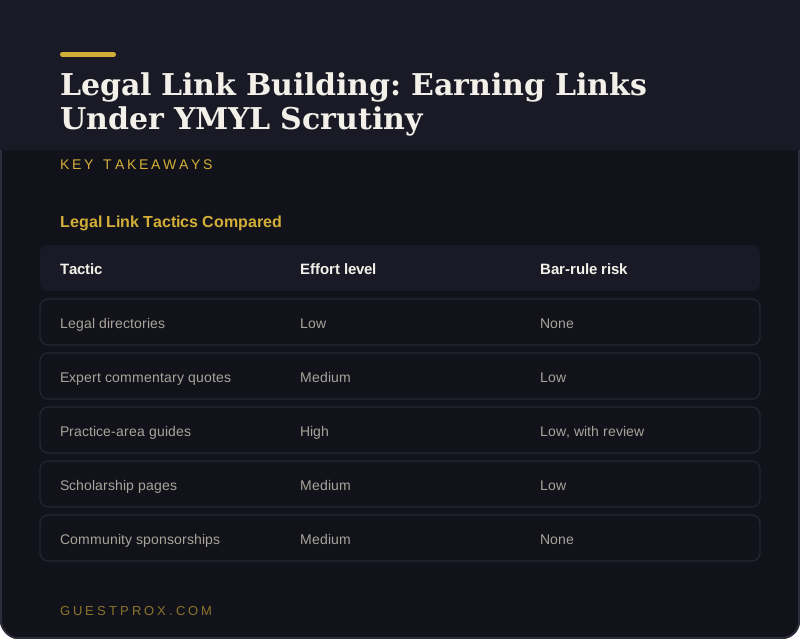
Where each tactic fits, and what it demands from the firm.
| Tactic | Effort level | Bar-rule risk | Best for |
|---|---|---|---|
| Legal directories | Low | None | Every firm, as foundation |
| Expert commentary quotes | Medium | Low | Firms with attorneys willing to be quoted |
| Practice-area guides | High | Low, with review | Competitive practice areas needing differentiation |
| Scholarship pages | Medium | Low | Firms with genuine community ties; diminishing returns |
| Community sponsorships | Medium | None | Local practices building local signals |
More on legal outreach and the publisher standards behind our placements.
Authoritative sources if you want to go deeper on this topic.
Yes, with care. Links themselves are not the issue; the content behind them must comply with your state's advertising rules. Avoid misleading claims, unverified superlatives, and implied guarantees in any content published under the firm's name. We build editorial placements with factual, professional copy, and we recommend having marketing content reviewed against your bar's rules before it goes live.
We don't publish prices. Message us on WhatsApp at +1 (213) 582-6001 for a quote.
Directories are a foundation, not a differentiator. Every competitor has the same profiles, and directory links carry no editorial endorsement, so Google treats them as citations rather than votes of confidence. Rankings move when publishers with editorial standards choose to cite your content, which requires the tactics in this guide.
Mostly no, at least not the way they used to. Universities grew wise to scholarship link schemes, and most .edu scholarship pages are now nofollowed or rejected. A genuine, funded scholarship tied to your community can still earn mentions, but budget it as community investment rather than a link tactic.
Legal is a YMYL vertical, and movement is slower than in most industries. Expect several months before new editorial links translate into ranking changes, longer in competitive practice areas and markets. Anyone promising fast legal rankings is selling something Google will eventually take away.
An agency can pitch expert commentary on your behalf, but the attorneys have to do the talking. We run 100% manual outreach to real publications and journalists, and we need quotable, responsive attorneys on your side to make commentary placements work. Firms that commit to fast turnaround on quotes get the most from this tactic.
Tell us your practice area and goals, and we will map out an editorial placement plan on real DR 40-90 sites. Message us on WhatsApp at +1 (213) 582-6001 or use the contact form.
Global Service Delivery