
Healthcare SEO sits under the strictest editorial bar in search. This guide covers the content and outreach tactics that earn medical backlinks from publishers who actually check their sources.
Healthcare link building is earning backlinks to medical and health websites from sources that meet the editorial standards applied to health content. Google classifies health topics as Your Money or Your Life, and editors at real publications know it, so health content gets fact-checked, reviewer-checked, and source-checked before anyone links to it.
That scrutiny changes the work. A generic wellness article pitched to a health blog will not survive review. Medical backlinks go to content with named authors, cited sources, and clinical accuracy, usually reviewed or written by qualified professionals. The bar is the feature, not the obstacle: links that clear it carry real weight.
This guide covers how to produce linkable health content, which publisher types actually link to healthcare sites, and the .edu and .org realities nobody should shortcut. It ends with a vetting checklist for healthcare placements.
Earning medical backlinks means publishing medically accurate, reviewer-backed content that survives YMYL scrutiny.
Editors who publish health content carry liability and reputation risk that lifestyle editors do not. A wrong claim about a treatment or condition can harm readers, so health publishers developed review processes that most niches never needed. Understanding those processes is the entire game.
Health publishers look for named authors with real credentials, cited primary sources rather than other blogs, and review dates that show the content is current. Content missing these signals gets rejected before the pitch is even read.
If your site publishes medical content without author credentials or review dates, fix that before any outreach. No reputable health publication will link to anonymous, undated medical advice. The content has to be link-worthy before it is link-pitched.
Google's standards for health content are strict, but a health editor's standards are stricter. Editors reject content that is technically accurate but poorly sourced, outdated, or written by someone with no standing in the field. Pitch content that would pass a medical reviewer's desk, because that is literally whose desk it lands on.
This is why link building for healthcare sites takes longer than general outreach. Each placement requires content that survives professional review, and there are no shortcuts around that.
The content that earns medical backlinks shares a pattern: it is useful to patients, defensible to professionals, and specific enough that journalists and bloggers cannot easily replicate it.
Clear, accurate explainers of conditions, procedures, and what to expect at each stage of care earn links from patient advocacy sites, health bloggers, and even news outlets covering health stories. The key is plain language backed by clinical accuracy.
Write the page a worried patient needs at midnight: what this diagnosis means, what the options are, what questions to ask the doctor. That page gets bookmarked, shared, and linked. Vague wellness platitudes get none of that.
Medical and allied-health associations, hospital community pages, local health coalitions, and nonprofit organizations link to member practices and useful resources. These are some of the most credible links a healthcare site can earn, and they come from genuine participation rather than outreach tricks.
Join the associations, contribute the content, sponsor the community health events. The links follow the involvement. Practices that treat association membership as a link line item get found out; practices that participate get cited.
University and hospital .edu links are among the most coveted in healthcare, and among the hardest to earn. They go to research, genuinely useful patient resources, and real institutional relationships, not to outreach emails asking for a link.
Do not buy .edu links, do not run scholarship schemes aimed at universities, and do not trust any vendor promising .edu placements at scale. Those links are either fake, paid, or about to be removed. The honest path is slower: publish content worth citing and build relationships with institutions you actually work with.
Healthcare outreach succeeds on relevance and credentials, not volume. A small number of well-matched pitches outperform bulk campaigns because health editors delete anything that smells mass-produced.
Health journalists need clinicians who can explain studies, outbreaks, and policy changes in plain language. A physician or qualified practitioner who responds quickly with quotable explanations earns links from news and health publications.
The turnaround expectation is hours, not days. Keep a roster of willing experts, prepare background lines on topics in your specialty, and treat journalist requests as urgent.
De-identified practice data, patient survey results, and local health statistics are linkable because nobody else has them. A dental practice publishing anonymized data on treatment outcomes by age group, or a clinic surveying local health concerns, creates content journalists cite.
Keep it ethical and compliant: aggregate and anonymize everything, stay within HIPAA and local privacy rules, and have the methodology reviewed. Data with questionable sourcing is worse than no data.
Health bloggers, patient advocates, and nonprofit sites maintain resource pages linking to useful guides. A genuinely superior patient guide, pitched with a personal note explaining why it helps their readers, still earns these placements.
The pitch has to show you read their page and that your resource fills a gap. Mass templates fail here because health editors spot them instantly. Manual, specific, short.
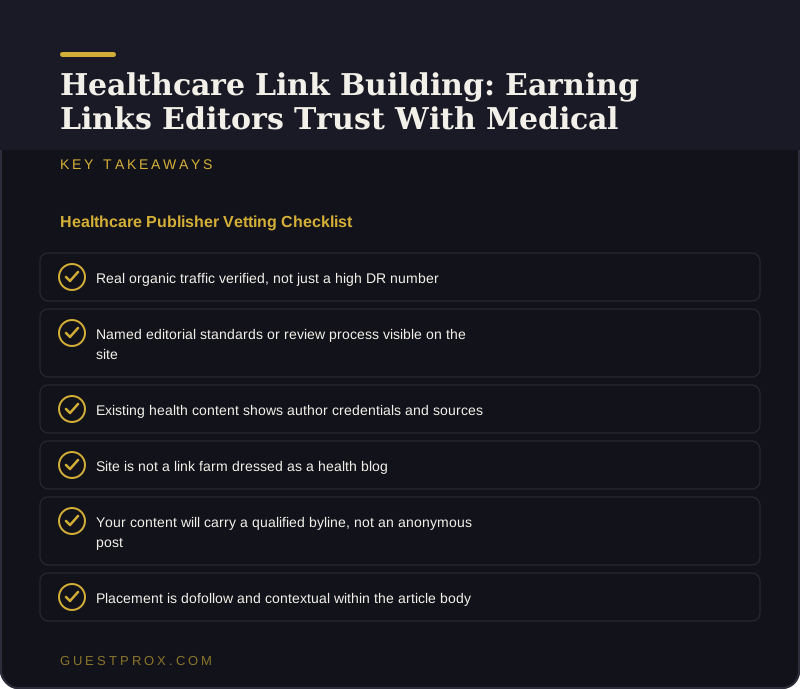
Run every prospective healthcare placement through this list before you pitch or pay.
More on YMYL outreach and how we verify publisher quality.
Authoritative sources if you want to go deeper on this topic.
Health content is Your Money or Your Life material, so both Google and health editors apply strict quality standards. Placements require medically accurate content with named credentials and cited sources, which takes more work per link. The upside is that links clearing that bar carry exceptional weight.
We don't publish prices. Message us on WhatsApp at +1 (213) 582-6001 for a quote.
Honestly, those are earned through real institutional relationships and citable content, not outreach campaigns. Any vendor promising .edu placements at scale is selling links that are paid, fake, or about to disappear. We focus on real health publications with real traffic, which move rankings reliably.
For clinical topics, yes. Health publishers expect named authors with relevant credentials or a listed medical reviewer, plus cited primary sources and visible review dates. Content without these signals gets rejected by editors before the pitch is read, so fix the content before spending on outreach.
Healthcare is a YMYL vertical and movement is gradual. Expect several months before new editorial links translate into ranking changes, longer in competitive specialties. We report every placement with its site and traffic data so you can see exactly what your campaign is building while rankings catch up.
Buying links means paying for placements on sites that sell them, which violates Google's guidelines and puts health sites at real risk. Our outreach is 100% manual: we pitch real editors at real publications with content worth publishing, and every placement is reported with its URL. No PBNs, no link farms, no paid insertions disguised as editorial.
Tell us about your practice or health brand, and we will map out an outreach plan on real DR 40-90 health and news sites. Message us on WhatsApp at +1 (213) 582-6001 or use the contact form.
Global Service Delivery