
Where links should point, how gift guides and reviewers fit in, and the pre-outreach checklist that makes every pitch land.
Ecommerce link building is the practice of earning backlinks to category pages, buying guides, and brand content, because thin product pages almost never earn links on their own. The framework decides what deserves links first, then earns them.
Most stores point every link at product pages and wonder why nothing moves. Product pages are thin, duplicative, and nearly identical across retailers; nobody links to them voluntarily. Category pages, buying guides, and brand stories are where links land, and internal linking then distributes that authority to the products that convert.
The framework below runs in a fixed order: decide what deserves links, make it link-worthy, then run outreach in channels built for commerce, gift guides, product roundups, reviewer seeding, and brand digital PR. Skip the middle step and every pitch fails.
Timing matters more in ecommerce than anywhere else. Gift-guide outreach starts in late summer for the holidays; nobody updates a roundup in December. Build the calendar around buying seasons, not around when you feel like doing outreach.
Earning backlinks to category pages, buying guides, and brand content works because thin product pages almost never earn links on their own.
A product page exists to convert, not to inform. Manufacturer descriptions, spec tables, and a buy button give an editor nothing to cite and a reader nothing to share. Even the best outreach cannot earn links to a page with no editorial value.
This is the structural trap most stores fall into: the pages that need links most are the pages least able to earn them. The fix is not better pitches; it is better destinations.
Category pages can earn links when they behave like guides instead of shelves. Add a genuine buying guide above or below the product grid: how to choose, what the differences mean, which option fits which buyer. Original photography and comparison tables turn a commodity page into a resource.
These enriched category pages become the link targets for every campaign below. One link to a category page lifts every product on it through internal linking, which is use product-page links can never give you.
On-site gift guides, data-driven buying studies, and brand story content are the linkable assets of ecommerce. A gift guide for a specific recipient, a study of what your customers actually bought last season, or the honest story of how the brand started all give editors a reason to link.
Build one flagship asset per quarter. A store with four strong guides a year has a year-round outreach calendar; a store with four hundred product pages has nothing to pitch.
Gift guides and best-of roundups are the highest-converting link channel in ecommerce. Editors update them seasonally and need fresh products, which makes a well-timed pitch genuinely welcome rather than an interruption.
Pitch early, lead with what makes the product giftable, and have samples ready to ship. Late summer for holiday guides, early spring for summer roundups. Miss the window and you wait a year.
Sending products to reviewers and niche bloggers earns the most natural ecommerce backlinks: real reviews from real users. The links are editorial, the content is trusted by readers, and the review lives on long after the campaign.
Seed selectively. Ten bloggers who genuinely cover your niche beat a hundred generic lifestyle accounts. Require nothing except honesty; disclosed, unpaid reviews are the ones Google and readers both trust.
Founder stories, sustainability commitments, and local manufacturing angles give journalists a narrative that product pitches never will. Digital PR for ecommerce works when the story is about the business, not the SKU.
Tie the story to something timely: a milestone, a data point from your sales, or a trend your brand embodies. Newsrooms link to stories; they ignore catalogs.
Map outreach to buying seasons a year ahead. Holiday gift guides get pitched in late summer, back-to-school content in early summer, and spring refresh roundups in winter. Every missed window is a year-long wait, so the calendar is the campaign.
Between seasons, run evergreen outreach: resource pages, broken-link building on buying guides, and reviewer seeding that is not tied to any date.
Track referral traffic from earned links, category-page ranking movement, and revenue attributed to organic search. Ignore vanity metrics like total link counts; ten links to the right category pages beat a hundred to random blog posts.
Report monthly and tie every placement to a target page. If a tactic is not moving its target page within two quarters, replace the tactic, not the target.
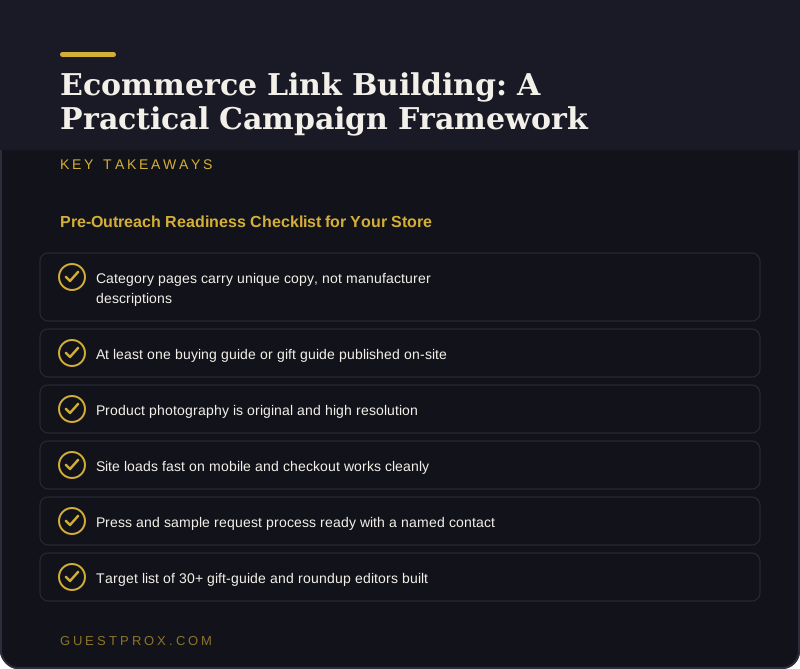
Do not pitch until every box is checked.
Services and guides that pair with an ecommerce link campaign.
Authoritative sources if you want to go deeper on this topic.
Plan for 3 to 6 months before category rankings move in competitive niches. Ecommerce links compound through internal linking, so early placements to guides keep lifting product pages for months. Seasonal timing compresses this: links earned before a buying season pay off inside that season.
No. Paid reviews with followed links violate Google's guidelines and FTC disclosure rules, and they put both the reviewer and your site at risk. Seed products with no strings attached and let honest, disclosed reviews earn their links naturally. The links are slower but they stick.
You need linkable content, not necessarily a blog. Buying guides, gift guides, and data studies hosted as landing pages work just as well and often convert better. What you cannot skip is the asset itself: outreach with no destination to point at fails every time.
We don't publish prices. Message us on WhatsApp at +1 (213) 582-6001 for a quote.
Yes, but fix the foundations first. A new store with thin category pages, slow mobile load, and no linkable content will waste every pitch. Build one strong guide, enrich your top categories, then start outreach. New stores that do this often outrank older competitors who never built linkable assets.
Yes, through internal linking. Authority flows from the linked guide to the product pages it links to, which is the entire reason the framework targets guides and categories instead of products. Link the guide naturally to relevant products and categories, and the rankings follow the link equity.
Our ecommerce outreach is 100% manual: gift guides, reviewer seeding, and brand digital PR on real sites. Message us on WhatsApp at +1 (213) 582-6001 or use the contact form.
Global Service Delivery