
Why SaaS SERPs are brutally competitive, and how to map link tactics to TOFU, MOFU, and BOFU content that actually earns links.
SaaS link building is the practice of earning backlinks to a software company's content and product pages, mapped to funnel stages, because SaaS buyers research long before they ever book a demo. The funnel mapping is the whole game: a link to the wrong page is a wasted link.
SaaS SERPs are among the most competitive in SEO. For any commercial keyword you face G2, Capterra, and TrustRadius, domains with enormous authority, plus well-funded competitors publishing the same comparison content. Links are the main lever that lets an independent SaaS site compete with aggregators.
The mistake most SaaS teams make is pointing every link at the homepage or pricing page. Those pages earn nothing on their own because nobody links to a pricing page voluntarily. Links flow to content that deserves them: original research, genuinely useful tools, and honest comparisons. The framework below matches each link tactic to the stage it serves.
SaaS buyers also research in a distinctive pattern. They read best-of roundups, compare alternatives, then check review sites before talking to sales. Links placed inside that research journey, on sites your buyers already trust, do double duty: they lift rankings and send qualified referral traffic.
SaaS link building is earning backlinks to a software company's content and product pages, mapped to funnel stages, because SaaS buyers research long before they buy.
For nearly every commercial SaaS keyword, the top results are owned by review aggregators. G2, Capterra, and TrustRadius combine massive domain authority with thousands of user reviews, and much of their content is affiliate-driven, which means they monetize the exact keywords you want. Outranking them head-on with a thin features page is not a plan.
The opening is specificity. Aggregators rank for broad terms; a SaaS company with strong links can own the long tail of use-case, integration, and industry-specific queries the aggregators cover shallowly. Links buy you the authority to compete where you can actually win.
Editors link to resources their readers will thank them for. A pricing page helps nobody's readers. This is the structural reason link building for SaaS must run through content: research, tools, comparisons, and guides earn the links, and internal linking passes that authority to the pages that convert.
Audit your site for linkable assets before any outreach begins. If everything worth linking to is a features page, the first job is building something worth linking to, not pitching.
Industry surveys, benchmark reports, and original data studies are the highest-yield link assets in SaaS. Journalists, bloggers, and even competitors cite fresh statistics, and every citation is a link. One strong annual report can earn links for years.
The research does not need to be academic. Aggregate anonymized product data, survey your users, or analyze a public dataset in your niche. What matters is that the numbers are new and the methodology is honest.
Best-of and versus pages sit at the consideration stage, where buyers are actively comparing. These pages earn links through expert roundups, partner mentions, and inclusion in other sites’ comparison content. They also convert the referral traffic that TOFU links send down the funnel.
Keep comparisons honest. Readers smell a rigged versus page instantly, and editors will not link to one. A fair comparison that admits where competitors win earns more links, and more trust, than a rigged one.
Integration partners are an overlooked link source. Most SaaS tools integrate with a dozen platforms that maintain partner directories, integration marketplaces, and co-marketing blogs. Every integration is a potential link from a relevant, authoritative domain.
Review-adjacent authority matters too: detailed use-case pages and customer stories give review sites and affiliates something substantive to link to beyond your homepage. Build the pages your ecosystem wants to reference.
ROI calculators, free mini-versions of the product, and practical templates earn links for years with almost no maintenance. A well-built calculator gets embedded in blog posts and resource pages across your niche, each embed carrying a link.
The tool should solve one real problem completely, not tease the paid product. Generosity is the strategy: the more useful the free tool, the more links it earns, and the links lift the whole domain.
Joint webinars, co-authored guides, and integration announcements with partners produce links from both sides' audiences. Partners have the same incentive you do: content that ranks and converts. Propose the collaboration with the content half-built to make saying yes easy.
Start with the integrations your best customers actually use. A deep co-marketing relationship with three core partners beats shallow directory listings on thirty.
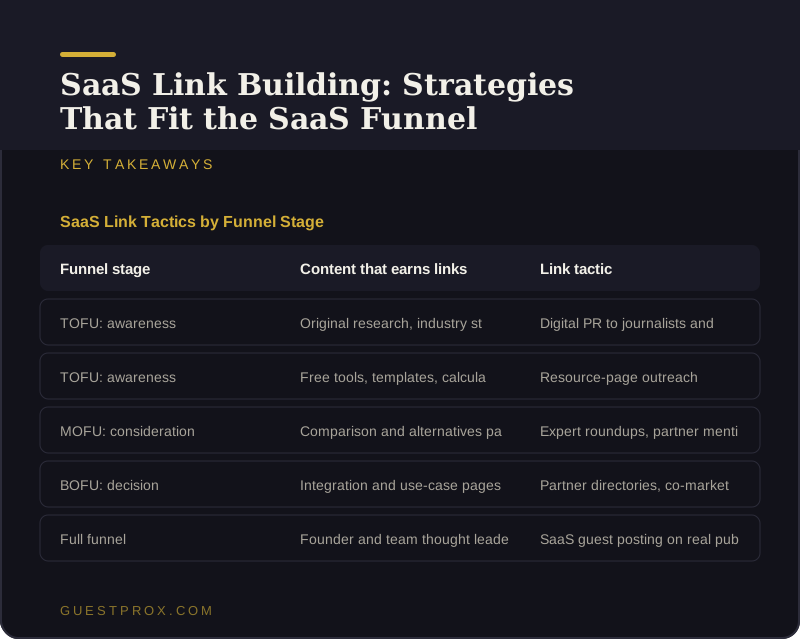
Match the tactic to the stage: each row shows what earns the link and how you get it.
| Funnel stage | Content that earns links | Link tactic |
|---|---|---|
| TOFU: awareness | Original research, industry statistics | Digital PR to journalists and bloggers |
| TOFU: awareness | Free tools, templates, calculators | Resource-page outreach |
| MOFU: consideration | Comparison and alternatives pages | Expert roundups, partner mentions |
| BOFU: decision | Integration and use-case pages | Partner directories, co-marketing |
| Full funnel | Founder and team thought leadership | SaaS guest posting on real publications |
Services and guides that pair with a SaaS link strategy.
Authoritative sources if you want to go deeper on this topic.
There is no fixed number; it depends on who you are up against. Pull the backlink profiles of the three competitors outranking you for your core keywords and count their referring domains to ranking pages. Your target is to close that gap with better links, not to hit an arbitrary total. Quality beats volume in SaaS more than anywhere.
Manual, editorial link building carries no penalty risk: real outreach, real publications, real content. What Google penalizes are link schemes, private blog networks, and paid links designed to manipulate rankings. GuestProx is 100% white hat with no PBNs, which is why our 1259+ placements across 57+ clients have stayed safe since 2018.
Expect 3 to 6 months before rankings move meaningfully in competitive SaaS categories. Links need to be crawled, and Google needs to see a sustained pattern, not a spike. The research and tool assets you build in month one keep earning links long after the campaign ends, which is why it compounds.
Build links to content, then let internal linking do the distribution. Research reports, tools, and comparison pages earn links naturally; homepages and pricing pages do not. A strong internal linking structure passes that earned authority to the pages that convert without wasting outreach on un-linkable URLs.
We don't publish prices. Message us on WhatsApp at +1 (213) 582-6001 for a quote.
Yes, if you have two things: genuinely newsworthy assets like original data, and someone who will pitch consistently for months. Most SaaS teams have the first and lack the second. Outreach dies the moment product work gets busy, which is exactly when an agency earning SaaS backlinks full-time pays for itself.
Our SaaS outreach is 100% manual on real DR 40-90 publications: research promotion, SaaS guest posting, and partner link programs. Message us on WhatsApp at +1 (213) 582-6001 or use the contact form.
Global Service Delivery