
On-page SEO is everything you change on your own site. Off-page SEO is everything other sites say about you. Here is what each one actually moves in the rankings, with concrete examples of both.
Off page SEO vs on page SEO comes down to where the work happens. On-page SEO is everything you change on your own pages: the words, the headings, the internal links, the page speed. Off page SEO is everything earned away from your pages: backlinks, brand mentions, and reviews that other websites give you.
Google treats them as two different kinds of evidence. Your on-page work tells Google what the page is about and whether it deserves to be considered. Off-page signals tell Google whether anyone else vouches for it. A perfectly optimized page can sit on page three for months if nothing off-page supports it.
This guide gives you concrete examples of each, shows where the two overlap, and helps you decide which one to fix first.
On-page SEO earns you the right to rank; off-page SEO gives Google a reason to believe you deserve to.
A genuinely useful guide is an on-page asset first. It only becomes an off-page asset when other sites link to it. Content quality sits at the boundary: you create it on your site, but its value compounds off your site.
The highest-ROI on-page work is the kind other sites want to reference: original data, clear definitions, step-by-step processes. Thin pages can rank with enough links behind them, but pages people cite need far fewer.
When someone searches your brand name after seeing you mentioned elsewhere, Google reads that as an off-page trust signal. You capture it on-page: a strong homepage, clear service pages, and visible reviews turn that branded visit into engagement.
The mention happens off-site. The conversion of that signal into something Google can measure happens on-site. Neither side works alone here.
Site owners check your site before agreeing to link to it. A slow, broken, or thin site kills placement rates no matter how good the outreach is. Fixing core on-page issues first makes every off-page dollar work harder.
We see this constantly: the same pitch gets twice the yes-rate when the target page loads fast and reads well. On-page quality is outreach use.
Here is what on page SEO controls, mechanism by mechanism. All three live inside your own site, and no backlink substitutes for any of them.
On-page SEO decides which queries a page can rank for at all. Title tags, headings, and body copy tell Google the topic, the angle, and the intent the page serves. If the words on the page do not match what the searcher wants, no amount of links fixes the mismatch.
Internal linking, sitemaps, and clean structure decide how much of your site Google actually sees. Large sites routinely leave important pages unindexed because nothing internal points at them. Fixing this is pure on-page work, and it surfaces rankings that links alone never would.
Clear formatting, fast loads, and content that answers the query quickly keep visitors on the page. Google watches whether searchers bounce straight back to the results. These are page-level factors, and no backlink can change them.
A backlink passes a vote of confidence from one site to another. Links from real sites with real traffic in your niche move rankings; links from irrelevant or dead sites do almost nothing. This is why we place guest posts only on DR 40-90 sites with verified traffic, and why traffic gets verified before we pitch.
Who links to you shapes what Google thinks you are about. A home-services site linked by renovation blogs looks more topical than one linked by random directories. Anchor text and surrounding content reinforce this: a contextual link inside a relevant article tells Google exactly which topic the vote applies to.
Anyone can claim expertise on their own site. Independent mentions, press coverage, reviews, expert quotes, guest posts, are evidence Google cannot get from you directly. Off page optimization is the work of building that outside evidence, our off-page SEO guide walks through the full playbook. It is the hardest part of SEO to fake, which is exactly why it carries weight.
There is no point earning links to pages that are slow, thin, or poorly targeted. Get titles, headings, internal links, and core content right first. Links amplify a solid page; they cannot rescue a broken one.
When on-page is solid and rankings have flatlined, the bottleneck is almost always authority. That is the moment for systematic outreach: guest posts on relevant, trafficked sites, earned mentions, and digital PR. Most sites we work with are in this exact position.
The tell is simple. If competitors with similar content outrank you, they are not out-writing you. They are out-linking you.
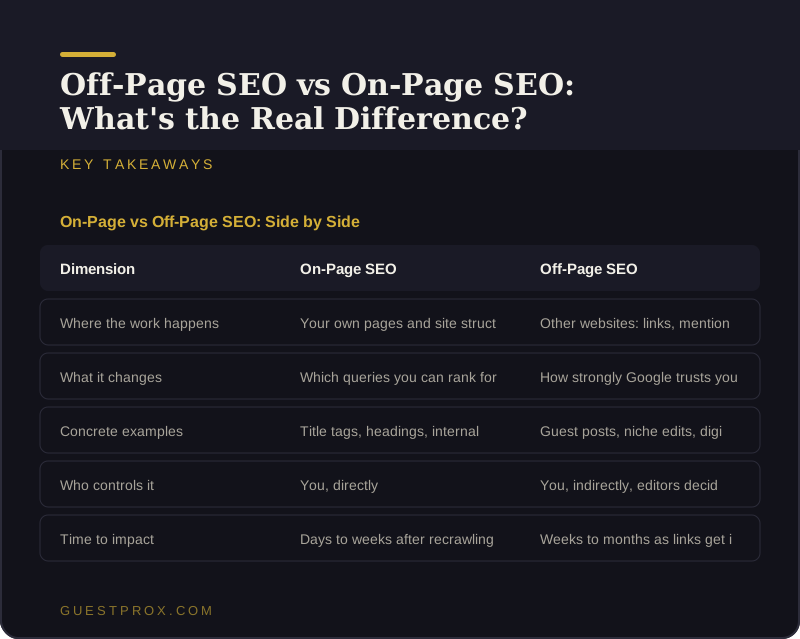
The same ranking viewed through both lenses.
| Dimension | On-Page SEO | Off-Page SEO |
|---|---|---|
| Where the work happens | Your own pages and site structure | Other websites: links, mentions, reviews |
| What it changes | Which queries you can rank for | How strongly Google trusts your pages |
| Concrete examples | Title tags, headings, internal links, page speed | Guest posts, niche edits, digital PR, citations |
| Who controls it | You, directly | You, indirectly, editors decide |
| Time to impact | Days to weeks after recrawling | Weeks to months as links get indexed |
The guides and services behind the concepts in this article.
Authoritative sources if you want to go deeper on this topic.
Sometimes, for low-competition or long-tail queries. If nobody serious is fighting for the keyword, a well-built page can rank on relevance alone. For anything competitive, every top result has off-page support, and on-page alone will not close the gap.
On-page first, always. Titles, headings, internal links, and genuinely useful content come before a single pitch goes out. Earning links to a half-built site wastes outreach effort and wastes the links themselves.
Expect weeks to months, not days. A new backlink must be crawled and indexed before it counts, and Google folds it into its trust assessment gradually. Most campaigns show movement in 6-12 weeks, with compounding gains after that.
Link building is the biggest part, but not all of it. Brand mentions, reviews, local citations, and digital PR all feed off-page signals. Links carry the most weight because they are the hardest to fake at scale.
Perfect on-page gets you considered; it does not get you chosen. Google's top spots go to pages that are both relevant and trusted. If competitors match your on-page quality and have stronger link profiles, they win.
We don't publish prices. Message us on WhatsApp at +1 (213) 582-6001 for a quote.
We earn guest post placements on real DR 40-90 sites through 100% manual outreach, no PBNs, fully white hat. Message us on WhatsApp at +1 (213) 582-6001 or email contact@guestprox.com and we will map out a placement plan for your site.
Global Service Delivery