
A DR 70 badge on a site nobody visits is a warning sign, not a selling point. Here is how to read the two numbers together, and what to do when they disagree.
DR estimates a site's backlink strength; organic traffic estimates how many visitors it actually earns from search. The two usually move together, but when they don't, the disagreement is the most informative thing on the page. A site with DR 70 and near-zero traffic is telling you its links were manufactured, not earned. When DR vs organic traffic tell different stories, believe traffic.
This happens more than most buyers expect. Expired domains get rebuilt with old link profiles intact, link schemes pump referring domains into thin sites, and sellers screenshot the resulting DR as proof of value. Traffic is the lie detector here: real authority leaves a trail of rankings and visitors that is expensive and slow to fake.
At GuestProx, traffic verification sits at the center of publisher vetting. We place on DR 40-90 sites, but only after confirming genuine organic traffic in the site's niche. The metric gets a prospect onto our list; traffic decides whether it stays there.
When DR and organic traffic disagree, trust traffic. Links are easy to manufacture; a real audience is not.

Knowing the three usual causes lets you spot these sites in seconds, instead of learning about them after paying for a placement.
A domain with a strong historic link profile expires, someone re-registers it, and publishes a generic blog on top. Ahrefs still sees the old referring domains, so DR stays high, but Google treats it as a new site with no topical history, and traffic never materializes. The tell: check the domain's history for a traffic cliff around the rebuild date.
Some sites exist purely to sell links. They trade links with hundreds of similar sites, inflating everyone's referring-domain counts and DR scores. Content is thin, publishing is erratic, and nothing ranks because nothing deserves to. The tell: traffic flat at zero while DR sits at 50 or higher.
Less malicious but equally worthless: genuine sites whose content never earned rankings, wrong topics, thin coverage, no topical authority. DR inherited from a few old links keeps the score respectable while the traffic graph tells the real story. The tell: a handful of ranking keywords, all branded or accidental.
Neither number works alone. Authority metrics are screening tools, and the useful read is the relationship between them. DR without traffic is a vanity score; traffic without a DR check can mean thin authority that is easily outranked.
DR and traffic roughly in the same league: a DR 55 site earning tens of thousands of monthly organic visits from keywords in its niche. Minor mismatches are normal, news sites spike, seasonal sites dip, but the long-term trend should make sense for the score.
DR 60 or higher with traffic under a few hundred visits a month, or traffic concentrated entirely in the brand name. Also watch for traffic that collapsed 80 percent or more at some point and never recovered, that usually marks a penalty or a rebuild the DR hasn't caught up with yet.
Don't dismiss low DR automatically. A DR 28 niche publication with 40,000 monthly visits from exactly your audience can outperform a DR 65 generalist on both rankings and referral traffic. Relevance plus a real readership beats a bigger number on an irrelevant site.
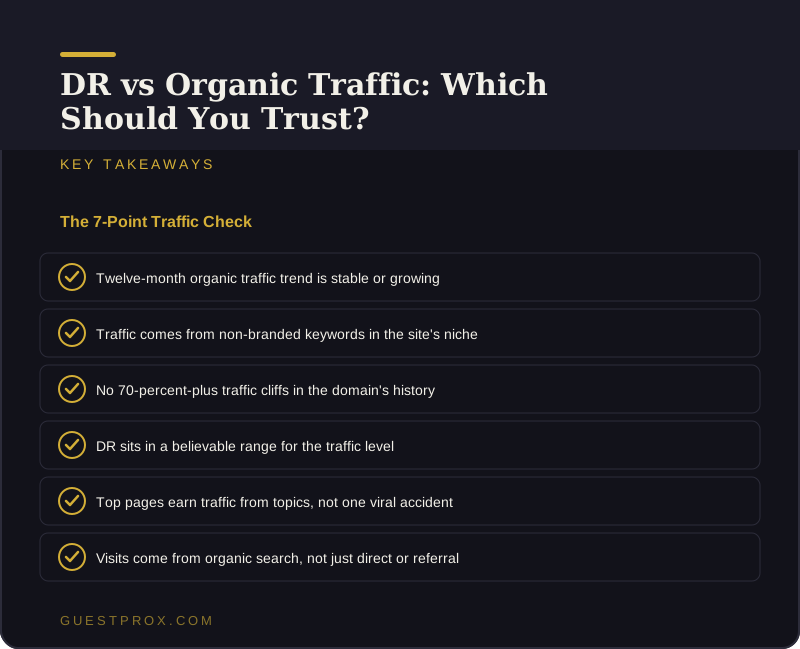
This is the traffic check we run on every prospect before outreach. It takes about ten minutes per site and has prevented more bad placements than any other single step.
A single month's snapshot lies; trends don't. We want stable or growing organic traffic with no unexplained cliffs. Gradual seasonal decline is fine, a vertical drop is not.
A site ranking only for its own name has no topical authority to lend you. We check that its ranking keywords match its niche and that real informational or commercial terms drive the visits.
DR 40-90 is our placement band, but it is the final gate. A site that passes traffic and relevance checks at DR 42 gets pitched; a DR 78 site with hollow traffic gets dropped. The order matters, it keeps us from falling in love with a number.
Run this on any site before paying for a placement.
More on metrics, traffic, and vetting publishers.
Authoritative sources if you want to go deeper on this topic.
Absolutely, this is the hidden-gem pattern. A DR 25 industry blog with 50,000 monthly visits from your exact audience delivers relevance, referral traffic, and ranking power that a DR 70 link farm never will. Judge the audience first and the metric second.
With SEO tools like Ahrefs or Semrush, which estimate monthly organic visits from ranking keywords. The estimates aren't perfect, but trends and orders of magnitude are reliable. We look at 12 months of history, not a single data point.
For judging real value, yes, and that settles the organic traffic vs DR debate for us. DR tells you about link power in the abstract; traffic proves the site earned an audience. We use DR as a filter and traffic as the decision-maker.
There is no universal threshold, it depends on the niche. A hyper-specialized B2B blog might do 5,000 visits a month and be excellent; a general news site needs far more. What matters is consistency, non-branded keywords, and topical fit.
Regularly. When traffic is hollow, near zero, brand-only, or collapsed after a penalty, we drop the prospect no matter how impressive the DR looks. Our clients pay for placements that move rankings, not screenshots of metrics.
Short-term fluctuations are normal and rarely affect a single link's value. What we guard against at vetting time is structural hollowness, penalties, rebuilds, manufactured profiles. A healthy site having a slow month is not the same as a dead site wearing a DR costume.
Traffic verification is built into every GuestProx campaign. Message us on WhatsApp at +1 (213) 582-6001 about your targets.
Global Service Delivery